If you are reading this with a 28-inch suitcase already open on the floor, here is the part that matters: on a Chinese high-speed train, you handle the bag yourself from beginning to end.
There is no airline-style counter where you drop it off. You put it through security, roll it to the platform, lift it onto the train, and find space inside the carriage. A cabin case is rarely a problem. Two large suitcases on a sold-out Friday evening are a very different story.
On paper, the rules take about a minute to understand. The practical part is knowing what stations actually check and whether your case will fit once you are onboard.
The short answer: An ordinary adult passenger can carry up to 20 kg of luggage in total. On a high-speed train, each item should measure no more than 130 cm when length, width, and height are added together. Each individual item must also weigh no more than 20 kg. Your bags will go through an X-ray before you enter the waiting hall.
Check three separate luggage questions
| Situation | Useful next step | Important limit |
|---|---|---|
| Bag size and weight | Apply the railway’s rule for the actual train and passenger. | Airline cabin-bag approval does not establish rail compliance. |
| Contents | Check current restrictions for batteries, liquids and other controlled items. | A small bag can still contain a prohibited item. |
| Handling | Choose luggage you can carry and store without blocking others. | Acceptance does not guarantee a convenient luggage space. |
What is the luggage allowance on a China high-speed train?
China Railway gives each passenger a free carry-on allowance:
| Passenger | Free luggage allowance |
|---|---|
| Adult passenger | 20 kg total |
| Child | 10 kg total |
| Diplomatic personnel | 35 kg total |
For the G, D, and C trains that most foreign visitors use, the limit for one item is:
- No more than 20 kg
- No more than 130 cm in total dimensions
That second rule is the one people often miss. It is not 130 cm on the longest side. It is the length, width, and height added together, including the wheels and handles.
A 55 x 35 x 23 cm suitcase comes to 113 cm, so it fits the rule. A 65 x 42 x 27 cm suitcase comes to 134 cm, which is already over it.
Conventional trains use a larger 160 cm limit, but do not rely on that number if your ticket is for a high-speed train. China Railway lists the current measurements in its English passenger FAQ and carry-on luggage guidance.
Can you bring a 24-inch or 28-inch suitcase?
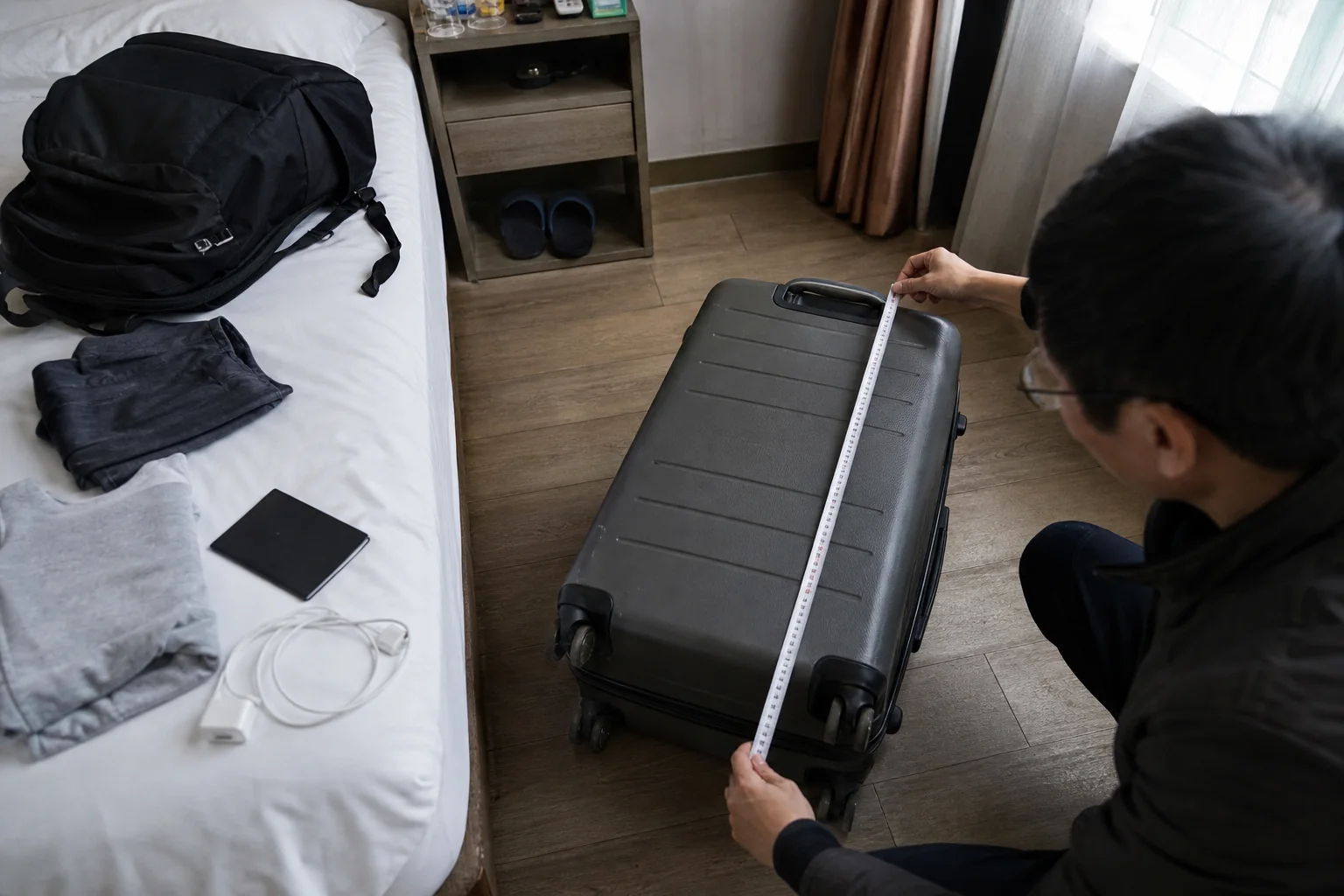
There is no reliable yes-or-no answer based on the advertised suitcase size alone, because manufacturers measure cases differently.
A typical 20-inch cabin suitcase will normally fit the formal size rule. Many 24-inch cases do not. A 28-inch case is usually well over 130 cm once the three sides are added together.
You will find plenty of travel reports from people who brought a large suitcase onboard without anyone measuring it. That does happen. Chinese railway stations do not put every bag on a scale or into a sizing frame. Staff can still stop a case that is obviously oversized, overweight, unstable, or difficult to carry.
More importantly, a suitcase can be inconvenient even when no one challenges it. Luggage racks fill quickly, aisles are narrow, and boarding can be fast. A bag you cannot lift yourself is a bad match for a busy train.
For a multi-city trip, one manageable suitcase and one small day bag per person works much better than one enormous case. You notice the difference every time you change hotels, take a metro escalator, or board a crowded train.
What actually happens at the station?
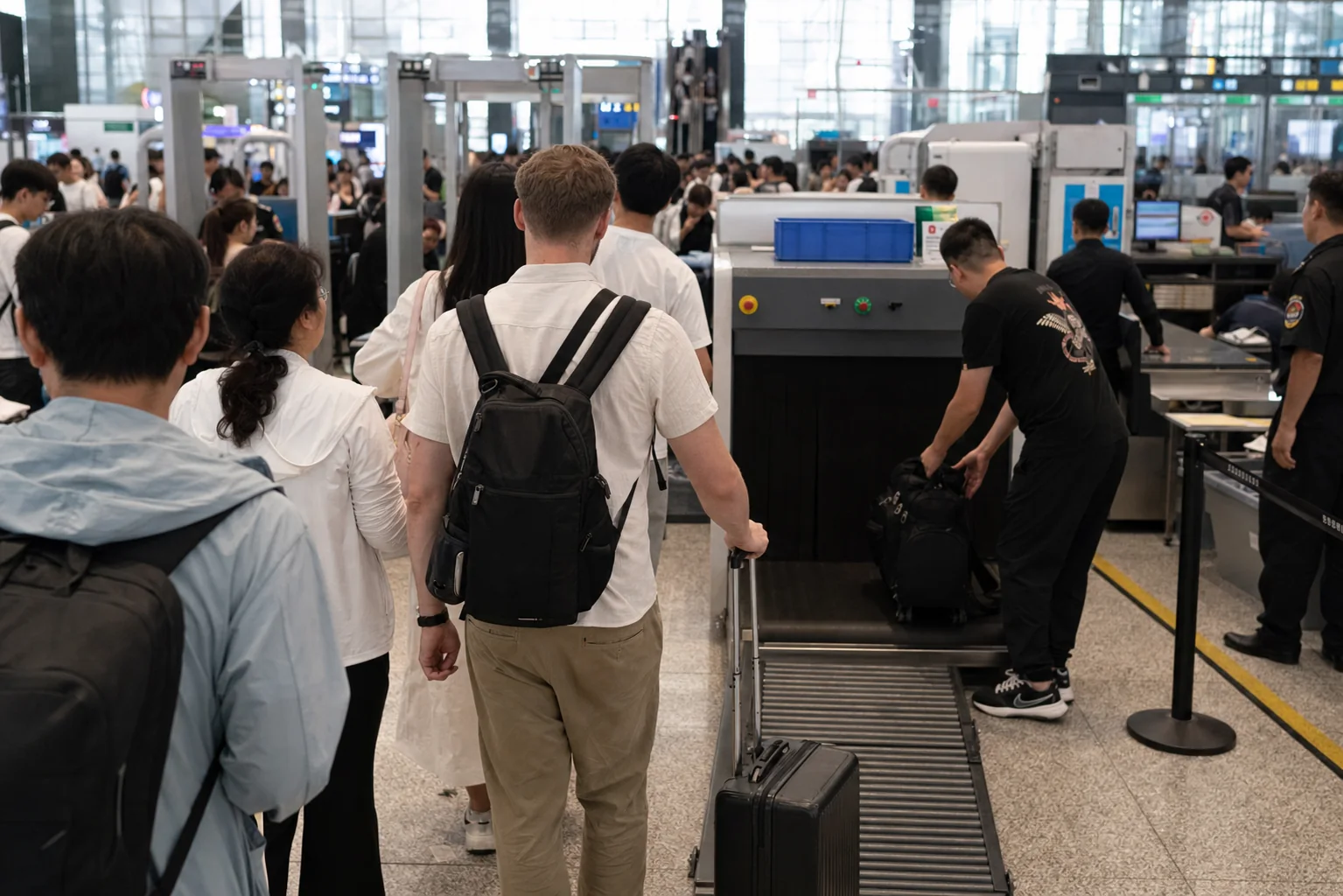
At the station entrance, you first pass an identity check using the passport connected to your booking. Your suitcase and smaller bags then go through an X-ray machine, similar to airport security. You walk through a security gate and may be asked to open a bag if something is unclear on the scan.
After that, you still have to move everything through the waiting hall, ticket gate, platform, and train door. Some large stations involve a surprising amount of walking. Beijing South, Shanghai Hongqiao, Guangzhou South, Xi’an North, and Chengdu East are not small buildings.
For a first journey, aim to reach the station 45 to 60 minutes before departure. This is not because the train is unusually complicated; large stations simply take time to cross. Add more time during Chinese public holidays or when traveling with children, several bags, or limited mobility. The train will not wait while you are still at security.
Keep your passport somewhere easy to reach. Burying it at the bottom of a suitcase is a mistake you only need to make once.
If you have not booked the train yet, start with our China high-speed train guide for foreigners. We also have a separate guide to using 12306 with a foreign passport.
Where does your suitcase go onboard?
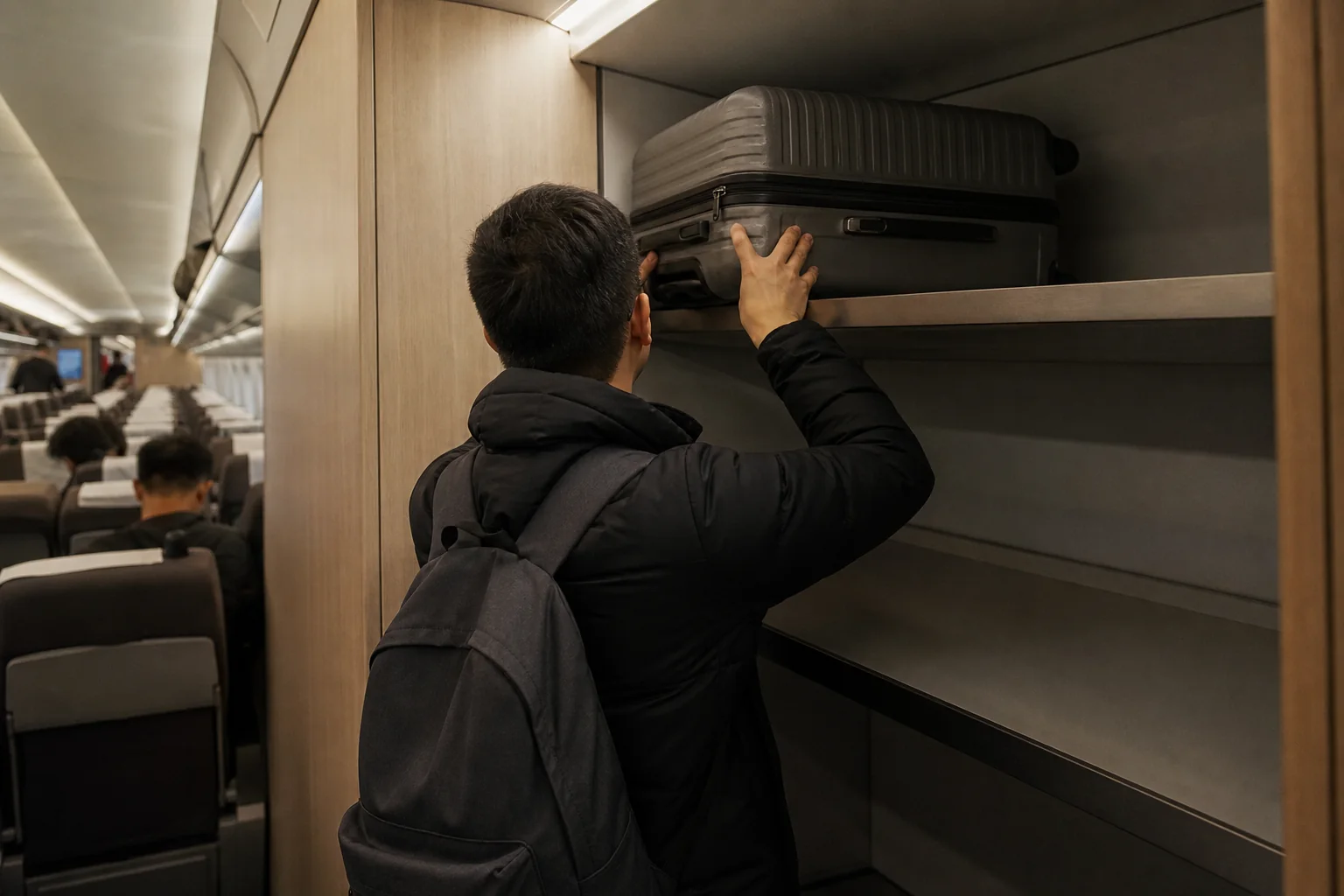
Small bags can go on the rack above the seats. Larger cases belong in the luggage space at the end of the carriage or, on some train models, in the storage area behind the last row.
The overhead rack is shallower than many people expect. A backpack or cabin case may fit; a heavy 24-inch suitcase often will not. Do not force a large case overhead or leave it where it could slide out when the train brakes.
China Railway’s onboard guidance says bags should be stable and properly placed, with heavier or awkward items stored in the large-luggage area or under a seat where appropriate.
The small things help more than people expect:
- Keep your passport, phone, wallet, medication, and power bank in a small bag at your seat.
- Put a name tag on your main suitcase. Black hard-shell cases have a way of looking identical when ten of them are together.
- Board when your gate opens rather than waiting until the last minute. The best luggage spaces are first come, first served.
- Check the end-of-carriage area before arrival so you are not fighting through the aisle after the train stops.
There is no need to stand beside your suitcase for the whole journey, but keep valuables with you.
Power banks: the label matters
Power banks are allowed when each unit is rated at no more than 100Wh and the manufacturer’s capacity label is clear enough for security staff to read.
Security staff need to be able to read the rating. A perfectly normal battery with a scratched or faded label may be rejected even when its actual capacity is below the limit.
Most common phone power banks are below the limit. A 20,000mAh model rated at 3.7V is about 74Wh. You can calculate it like this:
Wh = voltage x mAh / 1,000
Still, use the number printed by the manufacturer. A handwritten calculation is not a replacement for the original label.
Train rules and airline rules are not identical, so check both if your China trip also includes a flight.
Water, toiletries, sprays, and alcohol
Rail security does not use the same blanket 100 ml liquid rule as an international flight. A normal bottle of drinking water can go through, although security staff may ask you to take a sip or place it in a liquid scanner.
The restrictions become more specific when a product is flammable, pressurized, strongly alcoholic, or difficult to identify.
| Item | Current rail limit |
|---|---|
| Sealed and clearly labeled alcohol between 24% and 70% ABV | 3,000 ml total |
| Perfume, spray, gel, or similar non-pressurized product containing flammable ingredients | Container no larger than 100 ml; one of each type |
| Nail polish and nail-polish remover | 50 ml total |
| Hair spray, mousse, dye, insecticide, air freshener, and similar aerosols | Up to 150 ml each; one of each type; 600 ml total |
| Safety matches | Two small boxes |
| Ordinary lighters | Two |
Alcohol above 70% ABV is prohibited. Unlabeled bottles are also a bad idea, even if you know exactly what is inside them. Keep toiletries in their original packaging and avoid decanting unusual liquids into anonymous travel bottles.
The detailed list is published in the official prohibited and restricted items notice.
Knives, scissors, and tools
Do not bring a knife, pepper spray, self-defense device, or realistic weapon replica to the station.
Some sharp tools are completely prohibited; others cannot be carried onboard but may be eligible for formal shipment. The rules cover controlled knives as well as certain kitchen knives, professional cutting tools, hammers, axes, saws, bats, and similar objects.
Trying to debate a borderline item at the security belt is a poor use of your departure time. Leave knives, tools, and self-defense items out of the bag. Keep small grooming items in their original packaging.
What if your bag is too large?
Do not arrive expecting to pay an airline-style excess baggage fee at the platform. If staff reject an item, you may have to give it to someone outside the station, store it, discard it, or arrange delivery. That can easily mean missing your train.
China Railway offers a convenience shipping service at selected high-speed rail stations, but it is not available everywhere and not every restricted item can be shipped. The current high-speed rail shipping page lists participating stations and reference prices.
If you already know that your case is too large, send it to the next hotel in advance and ask the hotel to confirm that it can receive luggage. Do not make station shipping your only plan five minutes before boarding.
A packing setup that works for a multi-city China trip
For a route such as Beijing-Xi’an-Chengdu-Shanghai, pack for the train journey rather than for the maximum allowance on your international flight.
Take one suitcase you can lift into the train without help. Add one smaller backpack for anything you cannot afford to lose. Leave some empty space, because repacking a completely full case every three days gets old quickly.
Keep these in the small bag:
- Passport and travel documents
- Phone, charging cable, and labeled power bank
- Wallet and backup bank card
- Prescription medication
- One layer for the air-conditioned carriage
- Water and a small snack
If you are building a longer route, our 10-day China itinerary will help you judge how often you are changing hotels. The more transfers you add, the more valuable light luggage becomes.
Before you leave for the station
Do one final check the night before:
- Your total luggage is within the 20 kg adult allowance.
- No single high-speed rail item exceeds 130 cm in combined dimensions.
- You can lift and move every bag yourself.
- Power-bank labels are clear and each unit is no more than 100Wh.
- Toiletries, aerosols, and alcohol are in their original containers and within the limits.
- There are no knives, self-defense items, fuel, fireworks, or unidentified liquids in the bag.
- Your passport is easy to reach.
You do not need to travel with only a backpack. Just remember that nobody is taking the suitcase off your hands. If you can lift it, steer it through a crowd, and fit it into the proper luggage space, the journey is usually straightforward.
FAQ
Are suitcases weighed at Chinese railway stations?
Not every suitcase is routinely weighed, but staff can inspect or measure a bag that appears oversized or overweight. The official limits still apply, even when enforcement does not look like an airport check-in desk.
Can I bring a 20,000mAh power bank?
Usually, yes. A common 20,000mAh power bank rated at 3.7V is around 74Wh, below the 100Wh limit. The original capacity label must be clear.
Can I take food and water onto the train?
Yes, ordinary food and drinking water are generally allowed after security screening. Choose food that is easy to carry and not too strong-smelling in a shared carriage.
Is there checked baggage on a China high-speed train?
Most travelers carry their own luggage onboard. Separate luggage and delivery services exist at some stations, but they are not the normal check-in process and should be arranged in advance.
Do the same rules apply to Hong Kong cross-border trains?
This guide covers domestic mainland China high-speed trains. Cross-border journeys may involve additional railway, customs, and station rules, so check the notice for your exact route.
Make the train fit the trip
A three-hour train ride can still consume half a day once you include the trip to the station, security, waiting, boarding, and the transfer to your next hotel. This is the part that generic itineraries tend to leave out.
At LOCLYX, we build independent China trips around the journey as it really happens: which station to use, how much transfer time to leave, where to stay, and when another city would make the route more tiring rather than better. The plan is built for your dates and travel style, not copied from a group-tour schedule.
About the author. Henry writes for LOCLYX about independent travel in China. His guides focus on the questions that usually appear after a ticket is booked: which station to use, what to pack, how much time to leave, and what the journey feels like on the ground.
Last reviewed: July 16, 2026. Railway rules and station practices can change. Check 12306 again before your journey.
Official sources
- China Railway 12306: English passenger FAQ
- China Railway 12306: Carry-on luggage rules
- China Railway 12306: Passenger trip reminders
- National Railway Administration and Ministry of Public Security: Prohibited and restricted items
- China Railway 12306: High-speed rail convenience shipping
- China Railway 12306: Onboard passenger safety guidance
Related decisions for this part of the trip
- China High-Speed Trains: Plan, Book and Board With a Passport
- China Domestic Flight Power Bank Rules: Check CCC
- Luggage Storage in China: Stations, Airports and Hotels
Turn this decision into a workable route
Luggage choices need to fit station access, train changes and hotel movement. LOCLYX is a China-based local team. We tailor a written plan to your dates, budget, interests, pace and constraints. Planning costs $19.9 per travel day; travel purchases are separate and we do not make reservations or provide ground services.
Use the relevant guides above to settle this question, then compare the full planning deliverable. Compare the sample itinerary and pricing and scope before using Plan My Trip. Delivery and revision conditions are in the published policy.
Update note
Editorial review: October 12, 2026. Use official and provider references for the route and service they cover. Operational availability, individual eligibility, medical decisions and local procedures require the appropriate current or professional check.