240 hour transit visa china 2026: the US citizen’s guide

TL;DR. US citizens can transit through mainland China visa-free for up to 240 hours (10 days) under the 240 hour transit visa china program, when heading to a third country. The clock starts at 00:00 the day after you land. You can travel across 24 provinces and 4 municipalities. You need a confirmed onward ticket. This guide covers every step of the 240 hour transit visa china: eligibility, documents, eligible ports, the immigration process, and the mistakes that get people sent home. Plan My Trip for a custom 8-day itinerary timed to your 240 hour transit visa china window.
Back in August 2024, a US client we will call Jake used the 240 hour transit visa china program on a San Francisco to Beijing to Tokyo itinerary. He had the 3-month validity, the onward ticket, the confirmed booking, and a hotel address in Chaoyang. He forgot one thing: a printed copy of his onward flight. The agent at Beijing Capital Terminal 3 could pull up his passport, but the airline app would not load on the immigration hall WiFi. Jake spent 40 minutes in a secondary inspection room while the supervisor sorted it out. He made his flight to Tokyo. He also sent us a long message that night, which is why this guide exists.
The story is not rare. It is the most common version of a 240 hour transit visa china delay we see. The fix takes ten seconds at home: print your onward flight, put it in your carry-on.
What the 240 hour transit visa china actually is
The 240-hour visa-free transit (also called the 10-day TWOV, Transit Without Visa) is China’s most generous short-stay option for citizens of 55 countries. It started as a 72-hour program in 2013, expanded to 144 hours in 2019, and was extended to 240 hours on December 17, 2024.
The official policy, from the English Wikipedia summary of China’s visa policy:
“China offers 240-hour (10-day) visa-free stay for citizens of 55 countries, to enter and exit at any eligible port of entry, if their onward travel to a third country/territory (including Hong Kong, Macao, or Taiwan) is within 240 hours (10 days).”
The critical phrase is “third country/territory.” This is where most rejections happen, and it is the rest of this article.
Are you eligible? A 60-second checklist
You can use the 240 hour transit visa china program if every one of these is true:
- You hold a passport from one of the 55 eligible countries (US is on the list)
- Your passport is valid for at least 3 months past your date of arrival in China
- You have at least 1 blank page in your passport
- You are arriving in mainland China from one country or territory and departing to a different one within 240 hours
- You have a confirmed onward ticket to that third destination
- You are entering through one of the 60+ eligible ports of entry
- You are not on any Chinese immigration watch list, do not have a recent Chinese visa refusal stamp, and have not violated Chinese immigration law in the past
If any of these is not true, the 240-hour option is closed to you. You would need the standard tourist visa (L visa) or the 30-day visa-free entry (which has its own eligibility list).
The “third country” rule, with examples
This is the rule that trips people up. Hong Kong, Macau, and Taiwan all count as a “third destination” for this purpose, even though they are part of China politically. Here are the common scenarios:
| Your itinerary | Eligible? | Why |
|---|---|---|
| US → Shanghai → US | No | Departing to the same country you arrived from |
| US → Beijing → Tokyo | Yes | Third country = Japan |
| US → Shanghai → Hong Kong | Yes | Hong Kong counts as a separate destination |
| US → Beijing → Taipei | Yes | Taiwan counts as a separate destination |
| US → Shanghai → Macau | Yes | Macau counts as a separate destination |
| US → Beijing → US (after 9 days) | No | Still the same country |
| US → Shanghai → US (via Hong Kong, no stop) | No | A transit through HK without stopping is not the same as exiting to HK |
| Hong Kong → Guangzhou → Beijing → Tokyo | Yes | Arrived from HK, departing to Japan |
| Tokyo → Beijing → US | Yes | Tokyo is a third destination relative to US |
If your itinerary has any of the “No” patterns, you cannot use 240h. You will need the 30-day visa-free entry (if your nationality qualifies) or a standard L visa.
The 3-month passport rule
This is shorter than the 6-month validity rule most countries enforce, and the first thing US tourists overlook. If your passport expires within 3 months of your arrival date, you will be refused entry.
Example. If you are arriving in Beijing on October 1, 2026, your passport must be valid at least until January 1, 2027.
Most US passports issued in the last 5 years are 10-year passports for adults, so this is rarely a problem. If you have a passport expiring within 18 months, renew it before you book. You do not want to find this out at immigration.
5. china visa free for us citizens: the 30-day option (different from 240 hour transit visa china)
China announced a unilateral 30-day visa-free entry for ordinary passport holders of 38+ countries in late 2024. This is the best fit for a US citizen who does not have a third-country onward ticket. The eligible country list has been expanding in stages. As of mid-2026, the US is on the more recent additions in some bilateral arrangements, but the policy is in flux. Re-check the State Council’s English site within 30 days of booking. If the 30-day option is open to you, it is more flexible than 240 hour transit visa china: no third-country requirement, no 24-province limit, a full month on the ground.
The 240 hour transit visa china is the china 10 day visa free program. The 30-day program is a separate track. Do not mix them up.

The 60+ eligible ports of entry
240 hour transit visa china: where you can land in mainland China
You do not have to land in Beijing or Shanghai. The list of eligible ports for the 240 hour transit visa china has grown to over 60, covering almost every major city and many secondary airports. Some of the most useful for US tourists:
Tier 1 (international hubs, full service):
- Beijing Capital International Airport (PEK)
- Beijing Daxing International Airport (PKX)
- Shanghai Pudong International Airport (PVG)
- Shanghai Hongqiao International Airport (SHA)
- Guangzhou Baiyun International Airport (CAN)
- Shenzhen Bao’an International Airport (SZX)
- Chengdu Tianfu International Airport (TFU)
- Chengdu Shuangliu International Airport (CTU)
- Xi’an Xianyang International Airport (XIY)
Tier 2 (major cities, full service):
- Kunming Changshui International Airport (KMG)
- Hangzhou Xiaoshan International Airport (HGH)
- Nanjing Lukou International Airport (NKG)
- Wuhan Tianhe International Airport (WUH)
- Chongqing Jiangbei International Airport (CKG)
- Qingdao Jiaodong International Airport (TAO)
- Dalian Zhoushuizi International Airport (DLC)
Land and sea ports (less common for US tourists but available):
- Hong Kong → Shenzhen Bay Port
- Macau → Zhuhai Gongbei Port
- Multiple rail crossings (Beijing West Station for the K3/4 to Moscow, etc.)
Your point of entry must be an eligible port. If you fly into a smaller airport not on the list, you cannot use 240h. The LOCLYX itinerary tool defaults to the most-used entry ports and verifies eligibility as part of the build.
Where you can go once you are in: the 24-province rule
Inside China, you can travel freely across 24 eligible provinces and 4 direct-administered municipalities: Beijing, Tianjin, Shanghai, and Chongqing.
Provinces included (24):
Anhui, Fujian, Gansu, Guangdong, Guangxi, Guizhou, Hainan, Hebei, Heilongjiang, Henan, Hubei, Hunan, Jiangsu, Jiangxi, Jilin, Liaoning, Shaanxi, Shandong, Shanxi, Sichuan, Yunnan, Zhejiang. Tibet (Xizang) and Xinjiang have additional restrictions and often require a pre-arranged tour guide.
Provinces NOT included:
Inner Mongolia, Ningxia, Qinghai, and parts of Tibet and Xinjiang outside the listed open cities. You can transit through them on a direct flight, but you cannot stop and tour.
Direct-administered municipalities (always eligible):
Beijing, Tianjin, Shanghai, Chongqing.
The 24-province rule is one of the biggest improvements from the 144-hour program. Almost every popular tourist destination is included. The only major Chinese destinations restricted under 240h are:
- Tibet (Lhasa): requires a special permit and pre-arranged tour guide
- Xinjiang (Urumqi, Kashgar): generally requires a tour guide
- Inner Mongolia (Hohhot, Baotou): usually requires a tour guide
For a standard 8-10 day first-time China trip (Beijing + Shanghai, or Beijing + Xi’an, or Shanghai + Hangzhou + Suzhou), the 240h rule is more than enough.
What to do at the border: an 8-step process

Here’s the exact process at a typical eligible airport (Beijing Capital Terminal 3, the most-used US entry point):
Steps 1-4: Arrival, paperwork, queue
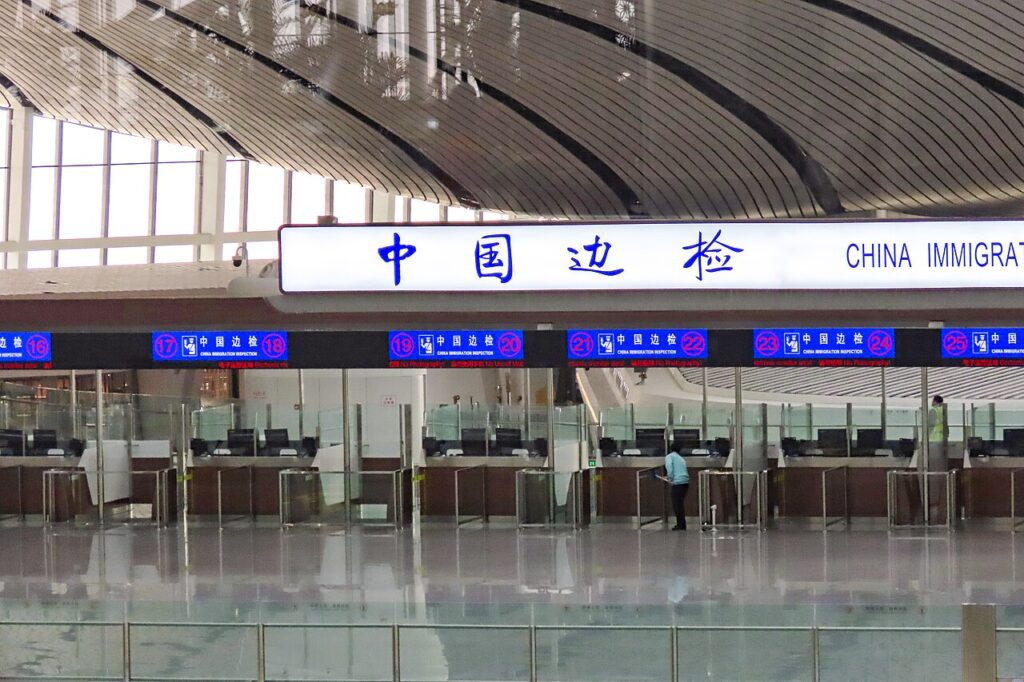
- Deplane and follow the “Foreign Passport” signs to the immigration hall. Most major airports have these in English above each lane.
- Fill out the Arrival Card. Flight attendants hand these out, but if you missed it there is a stack before the immigration counters. You will need: passport number, flight number, hotel address in China, address in your home country, and your onward flight number.
- Queue at the “Foreign Passport” or “240-Hour Transit” counter. If you don’t see a dedicated counter, use any “Foreign Passport” lane. Some airports (like PVG) have specific 240h counters. Look for the bilingual signs.
- Hand over your passport, arrival card, and onward ticket confirmation (printed or on your phone; they can scan the QR code). The agent will verify your onward destination is a third country and that your flight is within 240 hours.
Steps 5-8: Interview, permit, customs
- Answer three to five questions in English (or simple Chinese). Standard questions are: “What’s the purpose of your visit?”, “How long will you stay?”, “Where will you go in China?”, “Do you have a hotel reservation?”, “What’s your final destination?”
- The agent stamps your passport with a “Temporary Entry Permit” indicating your 240h window and the eligible provinces. This is your golden ticket. Keep it safe.
- Fingerprint scan and photo. Standard for all foreign visitors.
- Collect your checked luggage and clear customs. Declare any cash over $5,000 USD equivalent, expensive electronics in original packaging, or unusual food items.
Total time: usually 20-45 minutes if your flight is the only major arrival. Up to 90 minutes during peak hours (6-9 PM is the worst).
The LOCLYX pre-arrival checklist, sent to every client 72 hours before their flight:
- Passport valid 3+ months
- 1+ blank passport pages
- Printed onward flight confirmation (with PNR or booking code)
- Hotel reservation for at least the first night
- Travel insurance policy number (printed)
- Printed LOCLYX itinerary PDF (in case the hotel address is asked about)
- Two pens (one for the arrival card, one backup)
- 3 passport photos (rarely needed but good insurance)
Common mistakes that get people rejected (or stranded)
The four mistakes that get you denied at the border
1. Departing to the same country you arrived from.
The single most common mistake. US → Beijing → US is not a transit, even if you stop in Beijing for a week. The onward destination must be a third country.
2. Forgetting the 240h cutoff is real.
The clock starts at 00:00 the day after you arrive. Land on Monday at 11 PM, and you have until 00:00 twelve days later (not ten days, but in practice you can have less). Immigration will check your onward ticket.
3. Booking an onward flight that violates the third-country rule.
If your airline ticket shows US → Beijing → US, even with a stopover, the system will reject you at check-in or at the gate. Book a separate onward ticket if you have to.
4. Trying to enter through a non-eligible port.
Some smaller airports and most land borders (other than the major Hong Kong and Macau crossings) are not on the eligible list. Verify the airport code before you book.
Four more mistakes that get you stranded or fined
5. No printed onward ticket confirmation.
Don’t rely on the airline’s app. Immigration wants to see a confirmation number or printout. Take a screenshot AND a printout as backup.
6. Trying to do a same-day round trip.
US → Shanghai → Hong Kong → Shanghai → US is the kind of itinerary that gets the second Shanghai entry denied. You can re-enter after using up your 240h only by meeting normal visa requirements.
7. Bringing a drone without declaring it.
Drones over 250g require registration in China, and the customs process can be lengthy. Leave yours at home or declare it.
8. Misunderstanding the day-counting rule.
The 240h is 240 hours, not 10 days. 240 hours = 10 days. If you arrive on the 1st at 2 PM, your 240 hours end at 2 PM on the 11th. Plan your departure accordingly.
6. 240 hour transit visa china alternatives: how 240h compares to the other options
| Option | Max stay | Third country required? | Eligible countries | Best for |
|---|---|---|---|---|
| 240 hour transit visa china | 10 days | Yes | 55 (US included) | Trips with onward flight, stopover, or side trip from HK or Macau |
| 30-day visa-free | 30 days | No | 38+ (US in some recent additions) | Full-immersion China trip without specific onward ticket |
| Standard L visa | 30-90 days, multiple entry | No | All | Long trips, work, study, business |
If your itinerary has a clear onward flight to a third country, 240h is the easiest path. If you want to fly in and out of the US without an onward ticket, you need either the 30-day option (if your nationality is on the list when you travel) or an L visa.
The practical reality: most US tourists use 240h for these 4 itineraries
Based on what LOCLYX planners have built for clients in 2024-2026:
1. The “First Taste” 8-day grand tour
Beijing (3 nights) → Xi’an (2 nights) → Shanghai (3 nights) → Hong Kong departure. Covers the three most iconic cities and ends in HK, a true third destination.
2. The Hong Kong side-trip
US → Hong Kong (2 nights) → high-speed rail to Guangzhou (1 night) → Beijing (4 nights) → Shanghai (3 nights) → US. Hong Kong is the “origin” and the transit, US is the destination, but you need a 240h permit to cross into the mainland.
3. The 10-day pure China
US → Shanghai (5 nights) → Chengdu (3 nights) → Beijing (2 nights) → Tokyo departure. Two regional hubs plus the classic capital, exiting to Japan.
4. The stopover extension
US → Tokyo (3 nights) → Beijing (8 nights) → US. Your US-Tokyo flight gets a stopover in Beijing, you exit to Tokyo at the end of the 10 days, and your return flight to the US is a separate ticket (you will need to plan this carefully with your airline).
Each of these is fully covered by the 240h visa-free transit.
What happens if you overstay your 240 hours
Overstaying the 240h window, even by 30 minutes, is treated as a serious immigration violation. Consequences, from the official policy:
- Detention for questioning at the exit airport
- A fine of ¥500 per day of overstay, up to ¥10,000 maximum
- A 5-year ban from re-entering China on the visa-free transit. You can still apply for a normal L visa, but with a marked record.
- In severe cases, criminal charges
This is not a gray area. The day you must exit is the day stamped on your entry permit.
The LOCLYX approach: 240 hour transit visa china itineraries built by locals
The 240h window is generous, but only if you use it well. Most first-time visitors spend their first two days figuring out apps, finding an ATM, and getting a SIM working, and they arrive at the Great Wall on day 4 with only 6 days left.
A LOCLYX itinerary makes the most of the 240h:
- Day 1 is survival, not sightseeing. We pre-bind your Alipay, pre-load your eSIM, pre-set your DiDi home address, and pre-book your first hotel. You land, you clear immigration, and you go straight to your hotel.
- Days 2-9 are the actual trip. Hour-by-hour routing optimized for transport time, opening hours, and crowd patterns. Our planners test every route in the weeks before your trip.
- The morning of day 10 is a buffer. We plan your departure logistics (DiDi to airport, where to return your eSIM, what you can and can’t bring back) so you never feel rushed.
The price is $19.9 per day of the itinerary, delivered in 48 hours by a current local resident. Plan My Trip and tell us your 240h dates. We will have a draft in your inbox before you finish packing.
FAQ: quick answers on the 240 hour transit visa china
Very. The airline will check your booking before you board, and immigration will re-check when you land. A same-country return ticket is the number one reason US tourists get denied.
Yes. You need a confirmed, paid ticket, not a reservation or a “maybe later” booking. A PNR or booking code that can be verified in the airline’s system is required.
You cannot use 240h for that itinerary. You need the 30-day visa-free entry (if eligible) or a standard L visa. Or you can book the outbound and return legs as separate tickets, with the return leg starting in Tokyo or Hong Kong, then a separate cheap flight back to the US.
Yes, with a major caveat. You can exit to Hong Kong, Macau, or Taiwan, and re-enter the mainland within your 240h window using the same permit. You cannot exit to a non-eligible destination (a cruise to Japan from Shanghai, for example).
No. The whole point of the 240h program is transit. You need a third-country onward ticket. If you are planning a one-way move or long-term stay, this is the wrong program for you. Apply for an L visa or look at the 30-day visa-free entry.
Not strictly required for 240h, but strongly recommended. International hospitals in China cost $200-500 per visit without insurance. Travel insurance is $30-80 for a 10-day trip.
The 144h program (6 days) was the previous version. The 240h (10 days) replaced it on December 17, 2024. The eligible port list and eligible country list were also expanded. As of 2026, the 240h rule is in effect at all formerly 144h ports.
Yes. Each traveler needs their own valid passport, but the 240h program applies to all ages. If your child is on a separate passport, they get their own 240h stamp.
Most major cities have international hospitals (United Family Healthcare, Jiahui, ParkwayHealth) with English-speaking doctors. Pay out of pocket or use your travel insurance. The LOCLYX itinerary includes a list of the nearest international hospitals to your hotel for each city you visit.
You exit mainland China before your 240h window expires. If you are flying out, you check in normally. Your airline will see your valid Chinese exit stamp. If you try to board a flight within China after your window expires, you will be stopped at the gate.
About the author. Wen Zhang is a Beijing-based travel planner with LOCLYX. She has been guiding US tourists through 240 hour transit visa china trips since 2019. Last reviewed: July 8, 2026.